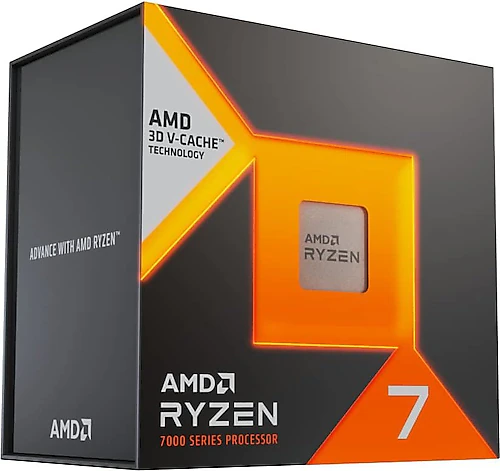
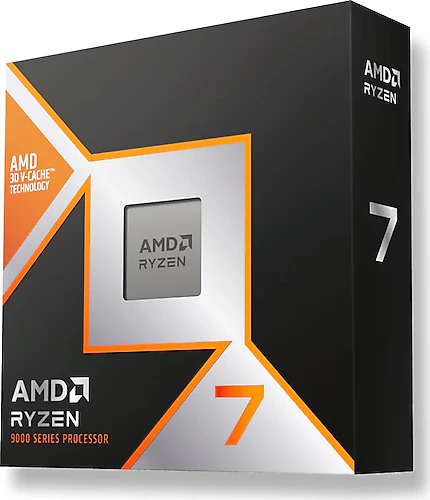
The AMD Ryzen 7 7800X3D and Ryzen 7 9800X3D share a similar foundation built around gaming performance: both are AM5 processors with 8 cores, 16 threads, 96 MB of cache, and a 120 W TDP. The main differences are the 9800X3D’s newer Zen 5 architecture and higher clock speeds, and the 7800X3D’s continued strength as a gaming option and its integrated graphics. Which difference matters more depends on the rest of your gaming system and your priorities.
Shared cache for gaming, different architectures and speeds
The 96 MB of cache in both models is designed to help the processor quickly access data it frequently needs in games. So the choice isn’t between one processor with a large cache and another without one: 3D V-Cache is central to the gaming-focused character of both.
The Ryzen 7 9800X3D combines Zen 5 architecture with second-generation 3D V-Cache. Its 4.7 GHz base and up to 5.2 GHz boost clock speeds are higher than the 7800X3D’s 4.2 GHz base and 5 GHz boost. In games where high frame rates matter and the processor can limit performance, the newer architecture and higher clock speeds are among the 9800X3D’s advantages. Giving this processor more consideration can make sense, particularly in systems with a powerful graphics card and a high-refresh-rate monitor.
However, you shouldn’t expect this difference to be the same in every game or system. At higher resolutions and graphics settings, the workload can shift to the graphics card, which may limit the benefit of a faster processor. In that kind of setup, the Ryzen 7 7800X3D remains a powerful gaming option. Your graphics card and the games you play are important factors in deciding how worthwhile it is to choose the 9800X3D.
Similar multitasking capability, different practical details
Both processors offer 8 cores and 16 threads, a shared advantage for anyone who keeps chat, streaming, or recording software running while gaming. Video editing, software development, and everyday productivity are also among the tasks either model can handle. The Ryzen 7 9800X3D’s Zen 5 architecture and higher clock speeds may also make it appealing for single-threaded tasks outside of gaming. On the other hand, if your priority is sustained, heavy workstation workloads that benefit from many cores, their shared 8-core design may not be the deciding factor on its own.
The Ryzen 7 7800X3D has integrated graphics. Being able to connect a display without installing a separate graphics card can be convenient during system setup or when using the system without a graphics card. This feature doesn’t replace the processor’s gaming-focused design; for gaming performance, it’s best considered alongside a dedicated graphics card.
Planning for the platform and cooling
AM5 socket, DDR5 memory, and PCIe 5.0 support are common to both processors. This means you can’t move a DDR4-based system to either processor by changing only the CPU; you’ll need to plan for an AM5 motherboard and DDR5 memory. It’s also important to check motherboard support for the 9800X3D and whether a BIOS update is needed. Both processors’ 120 W TDP means you should factor case airflow and a CPU cooler into your system plan.
The Ryzen 7 7800X3D is stated to come without an included cooler, so you’ll need to choose one separately. For the Ryzen 7 9800X3D, too, plan for an appropriate cooler and case airflow, especially if you expect long gaming sessions and heavy workloads. Both models support overclocking, but results depend on the hardware and settings; it’s best not to treat this feature alone as a reason to choose one.
Which one suits your priorities?
If you prioritize a newer architecture, higher clock speeds, and a strong match for games that approach the limits of your processor, the Ryzen 7 9800X3D is the better fit. You’re more likely to benefit from its gaming-focused features in a system built around a powerful graphics card and a high frame-rate target.
If your priority is strong gaming performance at a more affordable price, consider the Ryzen 7 7800X3D. If the price difference is significant and the newer model’s advantages are limited in your games or with your graphics card, the 7800X3D may be the more balanced choice. Its integrated graphics also offer extra convenience for anyone who wants to connect a display without a graphics card.
Ultimately, both are gaming-focused 8-core processors that share the same core platform and cache capacity. Choose the Ryzen 7 9800X3D if you prioritize a newer architecture and higher clock speeds; choose the Ryzen 7 7800X3D if you want a powerful gaming processor while keeping an eye on your budget. Don’t base your choice on processor generation alone: your graphics card, gaming goals, and the price difference between the two models should help determine the rest.