Although the Asus RX 9060 XT Dual and Gigabyte RTX 3060 Ti Gaming OC Pro 8G share the same 8 GB GDDR6 memory capacity, they address different usage priorities. Asus is aimed at users who want to keep their system layout simple with a dual-fan design and shorter card dimensions, while Gigabyte stands apart with its focus on 1080p and 1440p gaming, ray tracing and DLSS support, and more advanced cooling design. The decision should not be based solely on memory capacity or memory bus width: case space, preferred gaming technologies, and the desired look of the card are all key factors.
Asus RX 9060 XT Dual and Gigabyte RTX 3060 Ti Gaming OC Pro 8G: Core approach
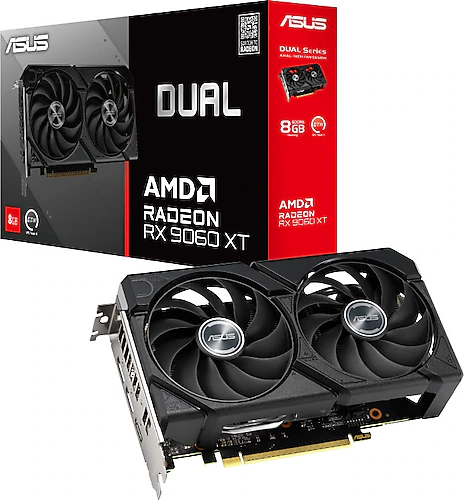
The Asus RX 9060 XT Dual combines an AMD chipset with 8 GB of GDDR6 memory and a 128-bit memory interface. Its dual-fan Dual design provides a balanced cooling setup and a simple physical layout. Including both HDMI and DisplayPort connections is a practical common point for users setting up monitors or other display devices.
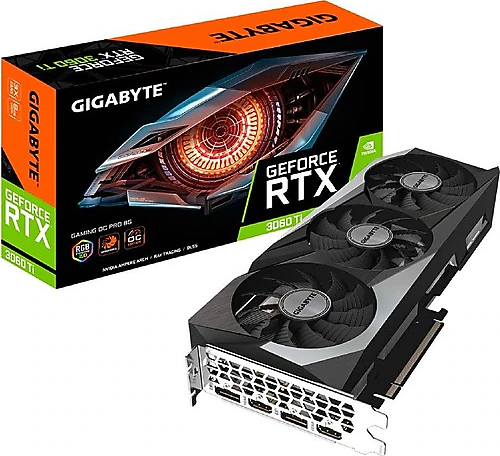
The Gigabyte RTX 3060 Ti Gaming OC Pro 8G is built on the NVIDIA Ampere platform and features a 256-bit memory interface. This figure does not define the card's overall performance on its own, but it shows that Gigabyte takes a different approach to memory architecture than Asus. The main distinction emerges in the gaming ecosystem Gigabyte offers. Ray tracing, DLSS, G-Sync, VR, and DirectX 12 Ultimate support make the card's character clearer for users who want to use these features with compatible games and displays.
For this reason, users who do not specifically seek NVIDIA gaming features and want a current AMD-based card with essential display connections may lean toward Asus. For those who want to play with ray-traced effects, use DLSS, or benefit from a G-Sync-supported display setup, Gigabyte offers a more direct option.
What makes a difference for gaming priorities
With its positioning in this review, the Gigabyte model is a graphics card particularly suited to 1080p and 1440p gaming systems. Its factory-overclocked 1770 MHz boost clock is meaningful for users who want a card with an OC profile without having to deal with manual tuning. In supported games, DLSS helps manage the balance between image quality and frame rate, while ray tracing brings a different visual approach to lighting, shadows, and reflections.
The available information for the Asus RX 9060 XT Dual indicates that it is an AMD-based solution suitable for gaming and graphics-focused applications. However, there is no shared information on ray tracing, image upscaling technologies, or gaming positioning at specific resolutions. Therefore, in a gaming-focused choice, Gigabyte's advantage comes less from a higher technical figure and more from its clearly stated gaming features and use case.
Both cards feature 8 GB of GDDR6 memory. This shared capacity removes memory amount from the center of the decision between the two models. Users working with very large texture sets, heavy effect layers, or major creative projects should still account for the 8 GB limit according to their own usage patterns.
Cooling, dimensions, and case planning
Physical design is one of the most concrete differences between these two cards. Asus uses dual-fan cooling, with a height of 120 mm and a width of 49 mm. Consistent with its short model name, this straightforward Dual approach offers a less complex appearance and a clear alternative for users who carefully plan component placement inside their case.
On the Gigabyte side, there is a WINDFORCE 3X cooling system. Three 80 mm fans, five composite copper heat pipes, pipes that directly contact the GPU, and an extended heatsink make up the card's more comprehensive cooling hardware. This design is a strong reason to choose it for those who place particular importance on cooling design during long gaming sessions. In contrast, the card measures 282 mm in length, 117 mm in height, and 41 mm in width. Case compatibility is not limited to length here; space for airflow around the card and its power connections should also be considered.
Gigabyte's 200 W power rating means that the power supply and case airflow should be included in the selection process. Since no power consumption information is provided for Asus, it would not be appropriate to make a direct comparison in this area. What is clear is that Gigabyte's larger triple-fan design requires more planning during system assembly, while Asus's stated dimensions address a different physical layout need.
Appearance and connectivity preferences
Both cards offer HDMI, DisplayPort, HDCP, and OpenGL 4.6 support. They therefore share common ground in terms of essential display connectivity and compatibility with OpenGL-based software. Both models provide flexibility for users with multiple displays or display devices using different connection types.
Gigabyte puts more emphasis on case appearance with a metal backplate and RGB lighting. Customizable with approximately 16.7 million colors and different effects, RGB does not change performance, but it is a genuine point of preference for users with windowed cases who want lighting coordinated with other components. Asus, on the other hand, remains on a simpler, function-focused path with its listed features. For those who do not want RGB or a flashy case aesthetic, this may mean a cleaner choice rather than a drawback.
Which one is for which user?
Users with a strong gaming priority, targeting 1080p or 1440p use, and wanting to benefit from NVIDIA features such as DLSS and ray tracing should choose the Gigabyte RTX 3060 Ti Gaming OC Pro 8G. Its triple-fan cooling, factory overclock, G-Sync, and VR support make this card more suitable for a gaming-focused system that values visual details. Users of video editing, 3D modeling, and visualization software that benefits from GPU acceleration may also consider Gigabyte while taking software compatibility into account.
The Asus RX 9060 XT Dual appeals to users looking for an AMD-based card with a 2025 production year, 8 GB of GDDR6 memory, and dual-fan cooling. Its simple cooling design, HDMI and DisplayPort outputs, and stated dimensions provide a sensible framework for those who prioritize case layout and essential usage needs. If NVIDIA-specific gaming technologies are not part of your decision, Asus's more straightforward hardware approach may better suit your needs.
Final choice
There is no single outright winner in this comparison. The Gigabyte RTX 3060 Ti Gaming OC Pro 8G is a stronger candidate for users who want to shape their gaming experience in detail, thanks to its gaming features, triple-fan WINDFORCE cooling, RGB design, and NVIDIA ecosystem. The Asus RX 9060 XT Dual, meanwhile, meets the needs of users looking for a more direct graphics card focused on compact installation, with its AMD platform, dual-fan design, and simple connectivity set. Your final decision should be guided by the space in your case and, above all, the software or gaming technologies you want to use.