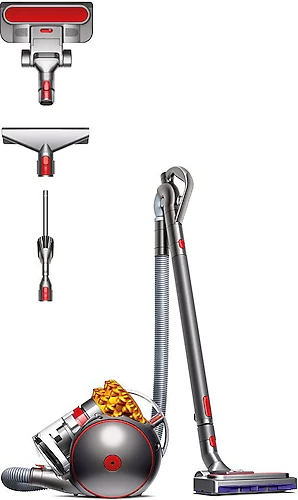
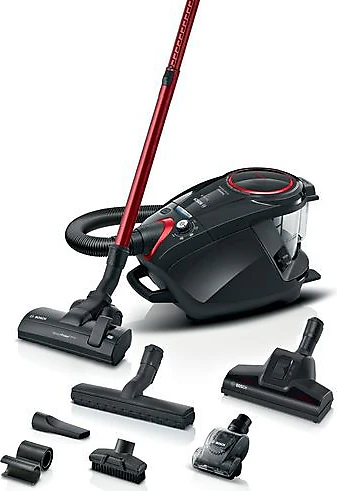
The Dyson Cinetic Big Ball Multifloor 2 and Bosch Serie 8 BGS7POW2 are corded vacuum cleaners for dry cleaning that do not use bags. Both offer a 360-degree rotating hose and automatic cord rewind. The main choice is between Dyson’s system designed to reduce filter maintenance and its Big Ball design, and Bosch’s longer cord, 3-liter dust container and attachments for different surfaces.
Reach and ease of use
The most noticeable difference in everyday use between these two models is cord length. Dyson’s cord is 6.6 meters long; Bosch’s is 11 meters. In a large home or one with few conveniently placed outlets between rooms, Bosch may make cleaning easier by reducing the need to switch outlets. Of course, reach also depends on outlet locations and the layout of your home. Dyson’s cord may be sufficient in smaller spaces or homes with well-placed outlets.
Both vacuums have a 360-degree rotating hose and automatic cord rewind, helping the hose move more easily when changing direction and making it easy to put the cord away when you finish. Dyson’s Big Ball body is designed to right itself if it tips over, and the body’s movement is another notable feature of its design. Dyson weighs 5.68 kg. Bear this in mind if you’ll often carry the vacuum up stairs or between rooms. No weight information is provided for Bosch, so it isn’t possible to compare the two models’ portability on this basis.
Dust container and maintenance preferences
Both models are bagless, so there’s no need to buy or replace bags. Bosch’s 3-liter dust container offers a capacity that may mean less frequent emptying as it fills up. Dyson’s notable approach is to reduce routine filter maintenance with its Cinetic dust separation system: the system is designed to separate fine dust and eliminate the need to regularly wash or replace a filter.
With either bagless model, you’ll need to empty the dust container when necessary and follow the maintenance instructions. Emptying the container can involve direct contact with dust, so anyone who wants to avoid that may prefer the sealed-bag setup of a bagged vacuum. Dyson’s filter-maintenance advantage doesn’t eliminate the need to empty the container, and Bosch’s larger container doesn’t by itself mean less filter maintenance.
Attachments: what surfaces do you clean?
The Bosch package includes a crevice nozzle, dusting nozzle, curtain brush, hard-floor nozzle, turbo nozzle and upholstery nozzle. This variety may be useful if you clean carpets, hard floors, curtains and upholstered fabrics with the same appliance. Having a separate turbo nozzle for carpets and upholstery nozzle for furniture makes it possible to switch to the right attachment for different tasks.
Dyson includes crevice, dusting, hard-floor and upholstery attachments. This set offers options not only for floors but also for spaces between furniture, shelves and fabric-covered surfaces. So neither model is limited to vacuuming open floor areas. However, the curtain brush and turbo nozzle are among the listed Bosch attachments, making Bosch a more comprehensive match for homes that regularly use these tools. If you mostly clean hard floors and don’t need these specialized attachments, cord reach and maintenance may matter more than the number of attachments.
How should you interpret power and noise figures?
Dyson’s power rating is 700 W, compared with Bosch’s 800 W. These figures indicate the electrical power of the motor; on their own, they don’t show suction performance or cleaning results on carpets. Rather than automatically interpreting a higher wattage as better cleaning, consider your flooring, the attachments and your cleaning habits together.
Bosch’s stated noise level is 72 dB. If you’re sensitive to noise or plan to vacuum at times when you need a quiet home, take this figure into account. No comparable noise-level information is provided for Dyson, so it wouldn’t be appropriate to make a direct judgment between the two models on this measure. Both products are designed for dry cleaning only; they should not be expected to collect liquids or provide wet cleaning.
Which model is right for whom?
If you want to change outlets less often in larger spaces, benefit from a 3-liter bagless dust container and use separate attachments for different tasks, from carpets and curtains to upholstery and hard floors, the Bosch Serie 8 BGS7POW2 may be a better fit. These advantages matter most if you’ll actually use the attachments and the longer cord suits your home’s layout.
The Dyson Cinetic Big Ball Multifloor 2 stands out with its Cinetic system, which reduces filter maintenance, its attachments for a range of everyday cleaning tasks, and its Big Ball design, which is intended to right itself if it tips over. If its 6.6-meter cord provides enough reach for your needs and you value spending less time on filter maintenance, Dyson’s approach may make more sense for you. Also consider its 5.68 kg weight if you’ll use it frequently on stairs.
When making your final decision, focus on your home’s layout, the variety of surfaces and your maintenance preferences rather than the wattage. Bosch stands out if a longer cord and a broader selection of attachments are priorities; Dyson stands out if reducing filter maintenance and the Big Ball design appeal more to you. Both offer bagless, corded cleaning; which is better depends less on these shared features and more on which differences will benefit you most.