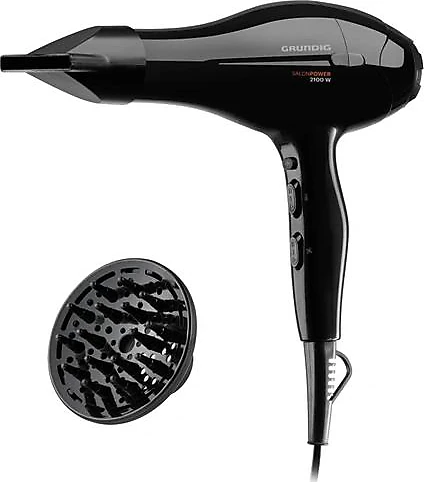
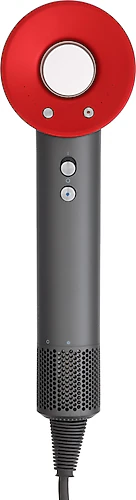
The Grundig HD 8020 and Powertec TR-3333 Plazma approach everyday hair drying with different needs in mind. Grundig offers straightforward use with basic settings and a Vigo attachment for styling curls. Powertec combines a higher power rating with three speed settings and a range of styling attachments. The key question is whether you mainly want to dry your hair or also regularly blow-dry and create different styles with the same appliance.
Power and settings
The Grundig HD 8020 has a power rating of 2100 W. Its two speed and three temperature settings let you adjust airflow and heat to suit your needs during everyday drying. The Powertec TR-3333 Plazma has a power rating of 2400 W and offers three speed settings. Both models have three temperature settings and a cool-air option. So they offer similar basic choices for temperature control and cool air, while Powertec provides one extra speed setting for greater flexibility.
That difference may matter if you often change settings or want finer control over airflow when moving from drying to blow-drying. On the other hand, if you tend to use the same settings, Grundig’s two speed options may be enough and simpler to use. There is also a difference in power ratings, but wattage alone does not determine drying time; hair length, thickness, and how you use the dryer all play a part. A higher number therefore does not necessarily mean faster drying for every hair type.
Attachments: defining curls or directing a blow-dry?
The most noticeable difference in use between the two models is their attachments. The Grundig HD 8020’s Vigo attachment spreads airflow over a wider area, offering an option for drying wavy or curly hair while helping preserve its natural shape. If using a diffuser is part of your curly-hair routine, this attachment makes the Grundig a direct fit for that need. You can also use it for basic drying on straight hair, but its distinctive accessory is aimed especially at those looking for a diffuser.
The Powertec TR-3333 Plazma’s attachments are suited to different drying and styling tasks. The narrow nozzle directs air onto a specific section, helping you blow-dry with a brush. The gentle-drying attachment offers an option for more controlled airflow, while the attachment designed to prevent frizz provides a styling alternative for those looking to reduce a puffy appearance. The magnetic attachment feature may also be convenient if you switch between pieces. Ionic technology accompanies these features; the result can vary depending on hair type and conditions of use.
In short, the Grundig’s Vigo attachment has a clear purpose, especially for curly or wavy hair. The Powertec’s range of attachments makes room for different uses, from focused blow-drying to gentle drying and styling aimed at reducing frizz. A wider choice of attachments is an advantage only if you plan to use those options.
Which one suits your priorities?
If you mainly dry your hair and do not often change settings, the Grundig HD 8020’s simple controls may meet your needs. The Grundig is also a more direct fit if you plan to use the Vigo attachment regularly to dry your curls with a diffuser. Both models have a cool-air option, so you do not need to choose between them based on that feature.
For regular at-home blow-drying, section-by-section styling, or choosing different airflow settings for different hair types, the Powertec TR-3333 Plazma is the more flexible package. Its three speed settings, three temperature settings, and attachments for different purposes will appeal if you want to dry and style your hair with one appliance. Its higher power rating is also part of this use case, though it should not be treated as a guarantee of results on its own.
Final recommendation
Start by choosing based on the attachment you will use: if a diffuser and curly-hair routine are your priority, choose the Grundig HD 8020; if blow-drying and a variety of styling options matter more, the Powertec TR-3333 Plazma is the better match. If you mostly want to dry your hair quickly without using attachments, Powertec’s extra options may not be a deciding factor, and Grundig’s basic settings may be enough. If you want finer control over settings and to try different styling approaches, Powertec’s third speed setting and variety of attachments carry more weight.