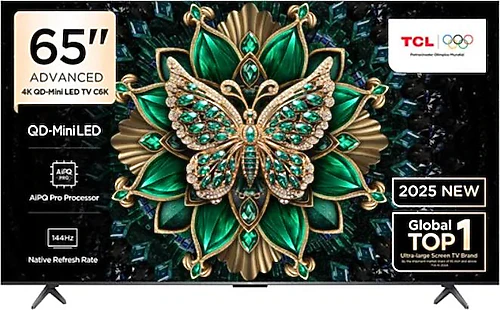
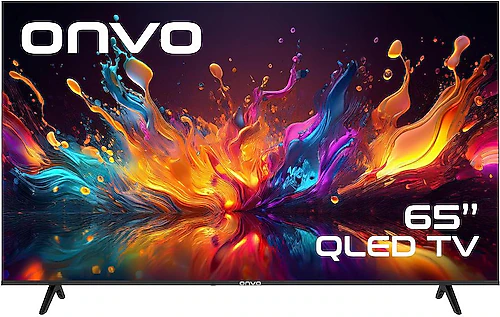
The TCL 65C6K and Onvo 65VQ90F3UA are aimed at anyone looking for a large living-room TV: both offer a 65-inch 4K screen, smart TV features and a built-in satellite receiver. The key difference is TCL’s Mini LED screen and 144 Hz refresh rate, compared with Onvo’s QLED screen and 60 Hz refresh rate. Your priorities for movies, broadcasts and gaming can help you choose between these two approaches.
Two different approaches to picture quality
Both TVs have a 65-inch screen with a resolution of 3840 x 2160. They’re therefore suited to similar living-room setups in terms of screen size and 4K content support. TCL uses Mini LED backlighting, a technology that allows more detailed control of light across different areas of the screen. This may be especially appealing for films and shows that combine bright and dark scenes. Support for Dolby Vision, HDR10+ and HDR10 also provides compatibility with content using various HDR formats.
Onvo’s QLED screen is a color-focused choice. QLED’s picture characteristics may appeal if you often watch colorful content, sports or animation. Since no HDR formats are specified for Onvo, it would not be appropriate to rank the two TVs definitively in terms of HDR. If HDR format support is a particular priority, TCL’s stated compatibility may make the decision easier.
Gaming and fast-moving content
If gaming, fast-paced sports or smooth motion are important to you, TCL’s 144 Hz refresh rate is a clear reason to consider it. With compatible sources, you can make use of the higher refresh rate, and the model’s game mode offers an option tailored to gaming. Four HDMI inputs can also make it easier to keep a console and other video sources connected to the TV. Still, check your console’s target resolution and refresh rate alongside the HDMI connection you plan to use.
Onvo’s 60 Hz refresh rate makes it a better fit for watching films, shows and everyday broadcasts. You can connect a console and play games, but TCL is the more compelling option for competitive players specifically looking for a high refresh rate. The difference isn’t that one model is better for everyone; it comes down to how much you prioritize smooth motion.
Smart TV, streaming and connections
TCL runs Google TV. Google Smart features are specified for Onvo. Both offer Wi-Fi and Ethernet, so you can set them up over a wireless network or connect them to your router with a cable. Both models also have screen mirroring, Bluetooth, a headphone output and two USB ports. These shared features are useful if you want to access online content, mirror video from compatible devices or listen privately.
Both models also have a built-in satellite receiver. This can give you a simpler setup for satellite broadcasts without a separate receiver box, though you should still check the connection requirements of your existing satellite antenna setup. TCL has four HDMI inputs, while Onvo has three. If you use several consoles, streaming boxes or other HDMI devices, this difference may make TCL more convenient. Three inputs may be enough in a home with fewer connected devices.
Sound and placement
TCL’s audio output is specified as 40 W RMS, compared with 24 W RMS for Onvo. This gives TCL higher output power for listening through the TV’s built-in speakers, but it doesn’t guarantee sound quality or that the volume will be sufficient for every room. TCL also supports Dolby Atmos. If movie sound is especially important to you, you might consider adding an external sound system, whichever model you choose.
Dimensions and weight are also worth considering when planning where to put the TV. TCL is listed as 1447 mm wide, 894.5 mm high and 17.2 kg in weight; Onvo is listed as 1446 mm wide, 834 mm high and 11.7 kg. When making room on a TV stand, check the dimensions and allow space for connection cables. If you’re considering wall mounting, check TCL’s 300 x 300 mm VESA support and choose a compatible mount. For Onvo, check mounting compatibility before buying as well.
Final verdict: which one suits your needs?
With Mini LED picture technology, the stated HDR formats, a 144 Hz refresh rate, four HDMI inputs and 40 W RMS audio output, the TCL 65C6K offers a more fully featured package for anyone looking to combine films, sports and gaming on one TV. Its advantages become more relevant if you expect to make particular use of its gaming and HDR features.
The Onvo 65VQ90F3UA is a suitable alternative for everyday broadcasts and online content, with its 65-inch 4K QLED screen, smart TV features and built-in satellite receiver. If a 60 Hz refresh rate suits your needs and you’re looking for a large-screen living-room TV with the essential connections, consider Onvo. In short, TCL is the better match if fast-paced gaming and broad HDR support are priorities; Onvo is a better fit if everyday viewing and a QLED screen matter more.