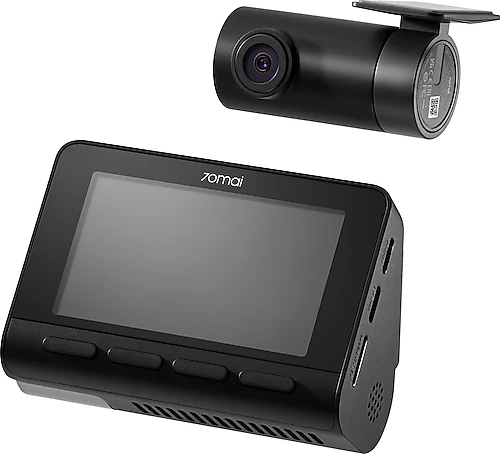
The 70mai A800SE + RC22 is a dual-camera set for drivers who want to record not only the view through the front windshield but also what happens behind the vehicle. 4K recording from the front camera is complemented by Full HD footage from the rear camera, while features such as GPS, parking mode, and emergency recording take the package beyond everyday use. Its compact 3-inch screen makes it easy to check recordings directly on the device.
Broader recording coverage with two cameras
The set’s main distinction is that the front camera records in 4K while the rear camera records in Full HD. It’s aimed at drivers who want detailed footage from the front while also recording vehicles approaching from behind or incidents that happen at the rear. The rear camera can also be used for reversing assistance, although its main benefit here is recording what’s behind the vehicle while driving. The camera angle is listed as 140 degrees. This helps capture a wider scene rather than focusing on a narrow area.
The 30 fps recording rate is a suitable option for smooth, standard driving footage. HDR and night vision support recording in changing or low-light conditions. These features alone don’t guarantee perfect footage in every situation; results also depend on factors such as road lighting, camera placement, and how clean the glass is. Still, having image-processing options that can help in both daytime and nighttime conditions means the camera isn’t designed only for bright daytime driving.
Useful features while driving and parked
GPS can link recordings to location and driving information, so when reviewing footage later, you can consider not only what happened but also the context of the journey. The G-sensor works alongside the emergency recording function, which is designed to protect important footage when a sudden impact is detected. Automatic recording start also means you don’t have to switch on the camera separately every time you start the vehicle. Voice control and mobile control offer additional convenience for basic operations, while the 3-inch screen is handy for a quick look at the menu or for checking recordings on the device.
Parking mode is a noteworthy feature for drivers who want monitoring while their vehicle is parked. Time-lapse recording also offers an option for capturing footage less frequently during extended parking surveillance. Before using these features, check how the camera will receive power while the vehicle is parked and what installation components are required: how parking recording works depends on the power connection. The capacitor-based design uses a capacitor instead of a conventional battery. This type of setup can be preferred in vehicle interiors that experience temperature changes, but it doesn’t mean the camera can operate on its own for a long time while the vehicle is off.
ADAS features are designed to provide helpful alerts while driving. They shouldn’t be used as a substitute for the driver’s attention or active control; the camera set’s main purpose is to record footage, not take over driving. The photo-taking feature also lets you capture still images when needed. This means the set can be used not only to record accidents but also to document damage while parked or a particular moment during a journey.
Installation and memory card selection
With a dual-camera setup, you need to position the rear camera appropriately as well as the front camera, and route its cable neatly through the vehicle. It’s important to keep the rear camera’s view clear of luggage, ensure the rear window stays clean, and route the cable so it doesn’t interfere with your view while driving. For best results, place the front camera where it won’t obstruct the driver’s field of vision and close to the area swept by the windshield wipers. The device uses a Type-C connection.
External storage capacity is listed as up to 512 GB, and the memory card type is listed as SD. Use this compatibility information when buying a card; its capacity must fall within the range supported by the device. Recording from both cameras uses more card space than recording only the front view. Regularly transferring recordings or choosing a card with sufficient capacity will help you be prepared for older footage to be overwritten.
Who should consider it?
Unlike basic single-camera solutions, the A800SE + RC22 meets the need for front and rear recording in one set. It’s a good fit in particular for drivers who use their vehicles frequently, want to document incidents while parked, or value being able to track journey recordings with GPS information. For someone looking for a simpler, more affordable camera, dual cameras, GPS, and parking mode may be unnecessary; in that case, a single-camera model may make more sense.
The extra cost of this set should be considered not just for the front camera’s 4K resolution but also for the coverage provided by the rear camera and the additional recording features. When comparing it with similar dual-camera options, look at the rear camera’s resolution, the power requirements for parking recording, card compatibility, and whether features such as GPS are included. If you’ll genuinely use these features, the A800SE + RC22’s two-way recording approach is a strong reason to choose it; if you only need basic recording through the front windshield, a simpler model may meet your needs more directly.