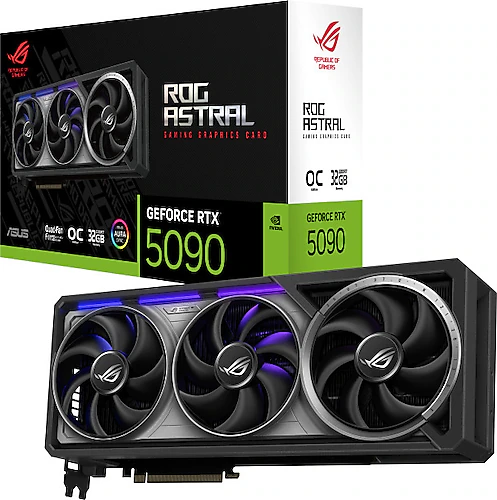
The Asus RTX 5090 ROG Astral OC Edition pairs NVIDIA’s top-tier graphics card with 32 GB of GDDR7 memory, a 512-bit memory interface, and a factory overclock. It’s an ambitious model aimed not only at gamers seeking high settings, but also at people working with large 3D scenes, high-resolution content, and GPU-accelerated production tasks. Its four-fan design, ARGB lighting, and the striking look of the ROG Astral series also make it more than an ordinary card meant to disappear quietly inside a case.
Designed for high-end gaming
The RTX 5090’s main promise is a powerful gaming experience, especially at high resolutions and with demanding graphics options such as ray tracing enabled. DLSS lets you take advantage of image-generation and performance options in supported games, while G-Sync-compatible displays can make use of variable refresh rates. DirectX 12 Ultimate support means the card is ready for today’s gaming ecosystem, including games that use next-generation graphics features. VR support also broadens its use with virtual reality headsets.
The factory overclock is one of the key features that sets this model apart from standard RTX 5090 options. The idea is to offer an overclocked version without requiring users to make additional adjustments. Actual gaming performance will vary depending on the game, resolution, processor, and system settings, so it’s best not to anchor expectations to a single FPS figure. To get the most out of a high-end card, it makes more sense to pair it with a powerful processor and a high-resolution, fast display; otherwise, some of the graphics card’s capacity may go unused.
32 GB of memory is useful for more than gaming
With 32 GB of GDDR7 memory and a 512-bit memory interface, this card also offers a solid foundation for working with large datasets. High-resolution texture packs and extensive game mods can use a lot of memory. In 3D modeling, scene creation, video editing, and GPU-accelerated creative applications, memory capacity also matters when working on larger projects. The card can also be used with compatible professional software and local AI workflows; results depend on the application and workload.
This capacity isn’t an advantage everyone will notice in everyday use. It matters more to people who run up against memory limits on their current system, work on demanding projects, or want to use the same graphics card for both gaming and production. For someone who only plays games at standard resolutions, the card’s generous memory may not, by itself, be a reason to buy it.
Astral design and installation considerations
The four-fan cooling setup is a prominent part of the design, intended to manage the heat of a high-end card under heavy loads. The number of fans alone doesn’t guarantee quiet operation or a particular temperature; airflow inside the case and the overall system setup matter too. ARGB lighting will appeal to those who want a coordinated look with compatible system components. HDMI and DisplayPort connections offer options for different display and VR setups; before buying, compare the card’s listed output details with the number of monitors you plan to connect and your preferred configuration.
When choosing a graphics card in this class, be sure to check the case’s interior length, the slot space available for the card’s thickness, and whether the power supply is sufficient. Comparing the exact dimensions and power connector requirements of the ROG Astral with the case it will go into can help prevent compatibility problems later. The power supply’s capacity matters, but so do the available connectors and the headroom it provides alongside the system’s other components. Leaving room for airflow around the card helps create a better environment for its four fans.
Who should consider it?
The most compelling reason to choose this card is that it offers a high-end model with plenty of memory, a factory overclock, and ambitious hardware features for users who want top-tier graphics performance in games and production work. Those targeting 4K gaming, looking to use ray tracing, or running demanding GPU workloads on the same computer may want to consider the ROG Astral. G-Sync, HDMI, and DisplayPort support also make it easier to tailor a display setup to the card.
Options in a nearby class, such as the RTX 5080, may be a more balanced choice if your performance needs and budget are more limited. If you won’t benefit from the RTX 5090’s extra capacity, stepping up to the higher-tier model may offer little return in everyday use. When comparing other RTX 5090 models, look beyond the underlying graphics chip and consider the cooler design, card dimensions, factory settings, power requirements, and price difference. The Astral OC’s four-fan design and overclock may make it appealing, but they should be considered alongside case compatibility and cost.
Ultimately, the decision depends on whether you’ll really use the extra capacity this class offers. If a large game library, a high-resolution display, and demanding production work all come together on one computer, the Asus ROG Astral OC Edition’s features make sense. For a more modest gaming system, a lower-tier card may create a more balanced setup by leaving room in the budget for other components.