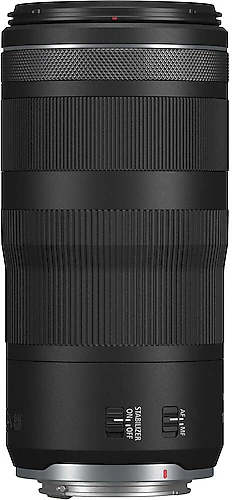
The Canon RF 100-400mm f/5.6-8 IS USM offers Canon RF users a broad telephoto range for framing distant subjects more tightly. Its 100-400 mm zoom range is useful in a variety of situations, from nature and sports photography to travel. Built-in image stabilization and autofocus are key features that make this reach practical for everyday shooting.
Flexible framing for distant subjects
The range from 100 mm to 400 mm makes it easier to adapt to subjects at different distances in a single day of shooting. At the 100 mm end, you can include more of the surroundings, while moving toward 400 mm lets you bring a distant bird, an athlete on the field, or an architectural detail closer. Since you do not have to rely solely on your feet to change the framing, it is especially practical in places with limited room to move, such as stadium stands, hiking routes, or viewpoints.
The zoom design is also an advantage when a subject moves within the frame. You can adjust the focal length without changing lenses, whether you want to show the surroundings of a bird or get a tighter, portrait-like composition. Of course, reaching 400 mm does not mean you can photograph every subject at whatever size you want; distance to the subject and your desired framing still matter. Even so, this range significantly expands your framing options compared with using a prime telephoto lens.
Use for nature, sports, and travel
This lens is naturally suited to subjects that are far away or impossible to approach. In wildlife and bird photography, it lets you maintain your distance while focusing on details. If you cannot get to the sidelines at amateur sporting events, you can frame the players more closely; at performances, shows, and outdoor events, you can also create more controlled compositions from where you are. Changing the focal length also makes it easier to adjust your framing while following a moving subject.
For travel, the telephoto perspective can help you pick out distant details in a landscape and create simpler compositions in a crowd. Those who want to photograph a distant scene on the street without drawing attention can also benefit from this reach, though the 400 mm field of view is narrow, so you will need to get used to finding your subject and placing it in the frame before shooting. This lens is not a specialized macro solution. While it can be used to magnify details of nearby subjects, those who want to photograph small objects from very close should consider macro lens options instead.
Image stabilization and autofocus
At telephoto focal lengths, small camera movements become more noticeable in the frame when shooting handheld. The image stabilization in the RF 100-400mm helps reduce the effects of these hand movements when taking photos. In suitable conditions, this makes it easier to work without setting up a tripod, capture a spontaneous scene while walking, or carry the camera in your hands for longer. One important distinction: image stabilization is intended to compensate for the photographer’s movement; it does not eliminate the need to choose a fast enough shutter speed to freeze moving subjects such as a running athlete or a flying bird.
USM autofocus is suited to a style of shooting where you need to focus quickly on a subject and keep shooting. With moving subjects in particular, you can rely on autofocus tracking rather than constantly adjusting focus manually. The result depends on the camera body you use, the subject, and the light; the lens’s autofocus alone does not guarantee perfect tracking in every condition. Still, having image stabilization and autofocus together makes this range more suitable for active shooting, rather than limiting it to use as a telephoto lens on a tripod.
What the f/5.6-8 aperture means
The aperture range is f/5.6-8. The brighter f/5.6 value applies at the 100 mm end, while f/8 applies at the long end of the zoom range. In daylight and outdoors, these values make it possible to take advantage of the long focal length. When light levels drop, however, the camera may need to use a higher ISO or a slower shutter speed. This matters if you want to photograph distant moving subjects: keeping the shutter speed fast enough to freeze motion can become difficult, especially in the evening.
For this reason, the lens makes more sense for those who prioritize reach and a portable telephoto option. Users who shoot sports in dimly lit halls, often work after sunset, or want a wide aperture for portraits with very blurred backgrounds may prefer a brighter telephoto solution. Lenses of this type can often be larger, heavier, or more expensive; when choosing, consider not only focal length but also the lighting conditions in which you shoot.
Camera compatibility and choosing a lens
This model is designed for a full-frame system using Canon’s RF mount. Check your camera’s mount type before buying: RF-compatible Canon bodies are the intended cameras; direct compatibility with bodies using a different mount, such as EF-M, should not be assumed. It can also be used on RF-mount APS-C bodies, though the smaller sensor makes the field of view appear narrower than it does on a full-frame body. This can be useful for framing distant subjects, but those who expect a wider frame should take the difference between camera bodies into account.
When changing lenses in dusty or windy conditions, keeping the camera body open for as little time as possible is part of general camera care. At 400 mm, a subject can leave the frame more easily, so tracking moving subjects may take some practice. If you have trouble finding a distant subject, locate it first at a shorter focal length, then zoom in. This small habit is useful, especially for bird and sports photography.
How does it differ from its rivals?
The Canon RF 100-500mm f/4.5-7.1 L IS USM is a more comprehensive option for those seeking greater reach, more telephoto flexibility, and the premium construction of the L series. In return, it occupies a higher tier. If reach up to 400 mm is sufficient and you want a more straightforward telephoto solution, the RF 100-400mm may be a more accessible choice. The main question is how often the extra 100 mm of reach and the higher-end lens features would be useful in your photography.
APS-C-oriented zooms such as the RF-S 55-210mm offer a shorter telephoto range, so the RF 100-400mm’s 400 mm end provides a clear advantage for reaching distant subjects. On the other hand, options with broader capabilities, such as Canon’s RF 100-500mm, may appeal to those seeking even greater reach. The most compelling reason to choose this lens is if you want a 100-400 mm range on the RF system, combined with image stabilization and autofocus. Consider the price difference alongside your budget and how much extra utility you would get compared with your other lenses; rather than assuming a fixed price, compare the options available at the same time.
Buying decision
The Canon RF 100-400mm f/5.6-8 IS USM is a telephoto zoom for RF users who shoot nature, birds, travel, and outdoor sports and find their standard zoom’s reach insufficient. Its 100-400 mm range offers framing flexibility, image stabilization helps with handheld shooting, and autofocus makes it easier to work with moving subjects. On the other hand, the f/8 aperture at the long end can make it difficult to photograph fast action in low light. It is a strong candidate if you mostly shoot in daylight and 400 mm of reach meets your needs; if dimly lit locations or greater reach are priorities, compare higher-end and brighter alternatives as well.