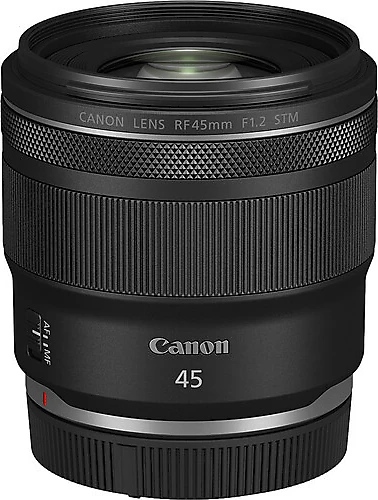
The Canon RF 45mm f/1.2 STM combines a slightly wider field of view than the familiar 50 mm standard lenses with a very bright f/1.2 aperture. This prime lens is aimed at Canon RF users who shoot portraits, everyday scenes, and in low light, and enjoy making backgrounds noticeably softer. Its most distinctive feature is that it offers an f/1.2 aperture in an STM lens outside Canon’s professional L series.
The natural perspective of 45 mm, the impact of f/1.2
A 45 mm focal length retains the feel of a standard lens while fitting a little more into the frame than a 50 mm lens. That small difference can be useful when photographing someone seated at a table, a street scene, or a portrait that you want to place in its surroundings while traveling. You can make your subject stand out without making the frame feel too tight, and often work comfortably without having to step back. Still, this is not a wide-angle lens: you shouldn’t expect it to fit an entire room into one frame in a cramped interior.
The f/1.2 aperture defines the lens’s character. Opening the aperture lets more light reach the sensor, which can make it possible to use a faster shutter speed or keep ISO lower in dim environments. The result depends on the scene and camera, but the lens gives you useful flexibility in situations with limited light, such as cafés, evening streets, and indoor portraits. Another benefit of the bright aperture is that it can make the separation between subject and background more pronounced. In close-up portraits especially, the eyes can remain sharp while the background takes on a soft appearance.
This look isn’t an automatic advantage for every shot. At f/1.2, depth of field is shallow; the closer you are to your subject, the narrower the area in focus becomes. For portraits, you need to focus on the eyes, and carefully track focus when your subject is moving. Stopping down gives better results for group photos or scenes where it’s important to keep the entire face in focus. In short, a wide aperture is not only an advantage in low light but also a creative tool that influences your shooting decisions.
STM autofocus and uses
Autofocus is one of the features that makes the lens practical for everyday use. The STM motor provides autofocus for still photography, reducing the need to adjust focus manually all the time across a range of scenes, from portraits to family and travel photos. Autofocus support is also useful for video shooters. However, focusing speed can vary depending on the camera body, shooting conditions, and subject movement; if you’re choosing this lens for professional sports or fast action, you shouldn’t look only at its aperture value.
This lens can be used for portraits that show the subject’s surroundings, natural-looking street photography, food and tabletop shots, event photography, and scenes in fading light. The 45 mm focal length is also well suited to moving closer to your subject and simplifying the background. On the other hand, it isn’t a focal length designed for specialist tasks such as macro photography, bringing distant subjects closer in the frame, or capturing a wide landscape from a single position. You’ll need to adjust your position to change the framing; that can give you freedom of movement, but it can also be limiting in tight spaces.
Compatibility and image stabilization
The RF 45mm f/1.2 STM is designed for mirrorless cameras with a Canon RF mount. On a full-frame Canon RF camera, 45 mm gives you a field of view close to a standard lens. It can also be used on an RF-S sensor camera, but the smaller sensor narrows the framing compared with full frame and gives you an approximately 72 mm equivalent field of view. This can work well for portraits, but you may need to stand farther back to capture the same area. Before buying, make sure your camera uses the RF system and that the framing you want suits your sensor size.
An important correction: this model does not have in-lens optical image stabilization. So, if your camera has in-body sensor-shift stabilization, you can benefit from it when shooting handheld; however, this should not be confused with stabilization built into the lens. Stabilization helps reduce camera shake, but freezing a moving person still requires a sufficiently fast shutter speed. It’s worth taking your camera’s stabilization capabilities into account, especially in dim conditions or when recording video.
How it differs from nearby options and whether to buy
Compared with simpler standard prime lenses such as the Canon RF 50mm f/1.8 STM, the main difference with the RF 45mm f/1.2 STM is its much wider maximum aperture. This gives you more options in low light and for softening the background; in return, the focal length is fixed and managing depth of field requires more care. The slightly wider framing of 45 mm can also be practical when working at close range. The more expensive Canon RF 50mm f/1.2 L USM is positioned in a different class; these two lenses shouldn’t be considered equivalent based on aperture value alone. Budget, how often you’ll use the lens, and professional requirements all factor into the decision.
It’s also worth considering whether a prime lens makes sense for you. If you enjoy working with a single field of view, compose by moving around, and regularly use the low-light flexibility or shallow depth of field provided by f/1.2, this model’s benefits become tangible. A zoom lens may be more convenient if you want to zoom in and out in every scene. Prices can vary by retailer and over time, so when making your decision, compare the difference with options such as the RF 50mm f/1.8 STM based on how much value f/1.2 would actually add for you. If you mostly shoot in daylight and at smaller apertures, paying the difference may not be necessary. If you prioritize portraits and low-light photography with a bright aperture, the RF 45mm f/1.2 STM becomes a distinctive and meaningful alternative in the Canon RF system.