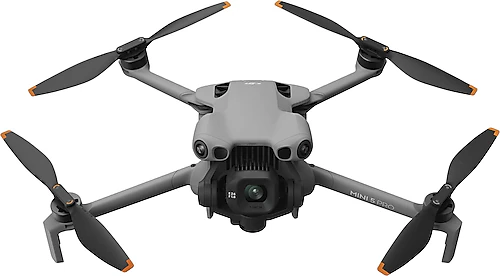
The DJI Mini 5 Pro is aimed at users who want to carry a drone with them without giving up automated shooting assistance and safety features. Its foldable 249-gram body takes up little room in a bag, while its 4K camera, GPS, obstacle detection and intelligent flight modes do more than capture aerial footage: they also help make it easier to plan a shoot.
A travel-friendly design, ready to shoot
When folded, the Mini 5 Pro measures 15.7 × 9.5 × 6.8 cm, making it a practical choice for anyone who would rather not carry a large equipment bag on a hike or camping trip. Getting it ready to fly does not require a lengthy setup, either: insert the battery, connect the controller and smart device, and you can start shooting. This convenience makes it easier to use the drone not only for planned productions, but also whenever you come across a scenic view.
Its light weight affects its flight characteristics as well as its portability. At 249 grams, it is easy to carry throughout the day, but requires more care in strong winds. It is good practice to consider the weather in places such as open beaches, wide fields or exposed ridges, and to make slow, controlled maneuvers in tight, obstacle-filled spaces. Checking local drone rules and permitted flying areas before takeoff should also be part of the plan.
4K footage and automated shooting assistance
The 4K camera can record detailed footage for a range of content, from vacation videos and nature scenes to cycling routes and real estate showcases. The stabilization system helps reduce the effects of shaking transferred to the camera as the drone moves. As a result, the footage depends less not only on the flight path, but also on how steadily the camera moves. HDR support can also be useful in scenes that include both bright and shadowed areas in the same frame. Still, the final look of the footage depends on the lighting, shooting settings and scene itself; the 4K label alone does not tell the whole story about image quality.
The smart modes are especially valuable for people shooting on their own. Follow Me makes it easier to track a moving person or object, while Point of Interest makes it easier to circle a selected subject. Preset movements such as Quick Shots help you create short, more polished, cinematic-looking shots without constantly fine-tuning the controller. Tracking can reduce the workload when filming running, cycling or walking, while circular movements that show a campsite or architectural structure from all sides can add variety to your footage.
GPS and hovering help the drone hold its position and let the operator focus on framing. Automatic return-to-home provides an extra layer of safety by bringing the drone back to its takeoff point if the connection is lost or the battery is running low. These features make the flight easier to manage, but they do not remove the responsibility to monitor the battery level, surroundings and return route. It is important to consider the return-to-home altitude and the area around the takeoff point before flying, particularly in places with buildings, trees or other obstacles.
Obstacle detection uses forward, rear and downward-facing sensors to help identify some nearby obstacles. This assistance can be useful when maneuvering in tight spaces or tracking a subject in the frame, but it should not be treated as a guarantee that every obstacle in every direction will be detected. Thin branches, wires and complex surroundings still require caution. Automated modes make piloting easier, but they are not designed to let you leave the drone entirely to its own devices.
Flight time, range and everyday planning
The stated flight time is up to 36 minutes with the 2788 mAh battery. This gives you a comfortable window to capture several different shots and explore the area on a single battery, although flying style, weather and surrounding conditions can affect actual flight time. Rather than relying on a single battery to last through an entire long day, it is better to plan your shoot around the available power. If you are planning a longer outing or back-to-back shoots, check whether the package you buy includes an additional battery; bundle contents may vary.
The stated control range of 10,000 m allows use across wide areas when connection conditions are favorable. It is best understood as a figure for ideal conditions, not a guaranteed distance in every environment. Local flight rules, line of sight and nearby structures determine how and how far you can practically fly. The maximum speed of 12 m/s can also be useful for moving shots, but in tracking modes, keeping a safe distance and prioritizing framing over speed will produce better results.
What does it offer compared with the DJI Mini 4K?
The DJI Mini 4K is a worthy alternative to consider if you have simpler, more basic aerial filming needs. According to the listed technical specifications, the Mini 4K has a 2250 mAh battery and an approximate flight time of 31 minutes, while the Mini 5 Pro has a 2788 mAh battery and a flight time of 36 minutes. The Mini 5 Pro’s main difference is not just its increased capacity: obstacle detection, automatic tracking and more comprehensive intelligent flight features provide more assistance while shooting.
Whether that difference is worth the extra cost depends on what you shoot. If you want to capture stationary landscapes and use a drone only occasionally, a simpler model may meet your needs. If you want to track moving subjects, shoot on your own or have extra detection assistance during flight, the Mini 5 Pro’s features become more useful. Since current prices and bundle contents can change, it makes sense to compare not just the drone’s price, but also what is in the box, such as an extra battery and controller.
Who is it for?
The Mini 5 Pro is a good fit for travel vloggers, creators of nature and sports footage, content creators looking for different angles with a compact kit, and people new to drones who want automated shooting assistance. Modes such as tracking and circular flight can reduce the need for a second operator when shooting alone. It can also be used to capture wide views and moving shots for real estate or outdoor event promotions.
By contrast, anyone planning long professional shooting days should account for the need for extra batteries, while those flying in strong winds should consider the extra care required by its lightweight body. The strongest reason to choose the Mini 5 Pro is that it combines portability with 4K shooting, tracking modes and flight assistance. If you will actually use these features, it is more likely to justify the price difference over a more basic option such as the Mini 4K; if you only take occasional landscape shots, a simpler drone may be enough.