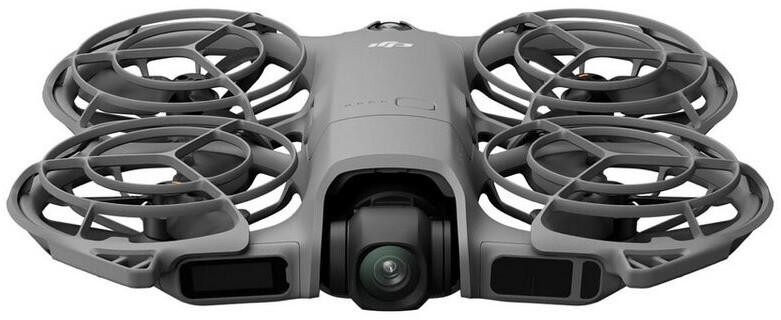
The DJI Neo 2 is a highly practical camera drone designed for those who say, “Drone footage would be great, but I don't want a large bag, a complicated controller or a long setup time.” With its 151 g weight and 171 x 167 x 54 mm dimensions, it can easily accompany you on hikes, bike rides or holidays; the convenience of palm take-off also makes it quicker to turn spontaneous ideas into aerial video.
Features that really work when filming yourself
ActiveTrack and Follow Me are among the Neo 2’s strongest features. For anyone who wants to remain in frame while walking, running or cycling, it can create tracking footage without the need for a separate camera operator. GPS positioning, the return-to-home function and omnidirectional obstacle avoidance support also make it easier to fly with greater confidence, especially on your first flights. For beginner users, this combination brings not only safety but also the freedom to focus on filming.
The point most frequently highlighted in user experiences on the product page is the easy-to-grasp control setup after the first few attempts and the success of the tracking modes in relaxed activities such as walking. On the other hand, in confined spaces and at higher speeds, choosing wider, more open routes for tracking delivers better results.
Creative video options from a small body
The integrated camera, with its 1/2-inch CMOS sensor, f/2.2 aperture and 16.5 mm focal length, is well suited to wide-perspective travel, sports and everyday-life videos. The 100 fps recording option at 4096 x 2160p UHD resolution helps make action moments appear smoother in slow motion. The combination of a 2-axis gimbal and electronic image stabilisation also helps the resulting aerial footage look more composed.
For photos, it offers 12 MP resolution, JPEG recording and an ISO 100 - 12,800 range. The ability to change exposure, white balance, ISO and video resolution settings is valuable for those who want to go beyond automatic shooting and compose images more deliberately in sunsets, bright snowy landscapes or high-contrast city scenes. The 49 GB internal memory also removes the need to carry a card for short shoots. However, because there is no microSD slot, those planning long holiday recordings should transfer their footage regularly.
Portable in a bag, with limits in the wind
Brushless motors give the Neo 2 a maximum speed of 43 km/h, a climb rate of 5 m/s and a descent rate of 3 m/s. Wind resistance of 12 m/s is a useful level for such a lightweight model; however, the low body weight is a reminder not to expect the calm stability of larger DJI models in strong and variable winds. In open areas, when shooting after checking the weather, the Neo 2 becomes a much more enjoyable companion.
Its C0 drone class and compact plastic frame support its lightweight-focused design. The sense of sturdiness and obstacle detection reduce the concern of approaching a bush or narrow passage; however, sensor support is not a substitute for flight rules, people nearby or obstacles that are difficult to detect, such as thin branches.
Flight time and control preferences
The stated flight time with a single battery is 19 minutes. While this is sufficient for short social media clips and travel footage with a few shots, a spare battery makes a noticeable difference for anyone who wants to create content all day. The battery is interchangeable; considering the 70-minute charging time of the 1,606 mAh flight battery weighing 46 g, packages with multiple batteries offer a more uninterrupted use scenario.
With 2.4 GHz and 5.8 GHz connectivity options and a 6,000 m image transmission range, it provides flexibility for composing shots remotely in suitable conditions. However, the Neo 2’s main appeal is capturing nearby moments quickly rather than long-distance flying. Those who want more precise route and camera management with a remote controller should check before buying whether their preferred controller setup requires an additional receiver/adapter.
Who is it for?
The Neo 2 is an excellent fit for first-time drone buyers, those who want to record holiday and outdoor memories on their own, people creating dynamic short videos for social media, and anyone looking for a small model they can carry with them every day. Those seeking a professional aerial camera with a large sensor, long flight times and an approach closer to interchangeable lenses should look at larger-class models.
If its price covers not only basic flight but also omnidirectional obstacle avoidance, smart person-tracking modes, 4K 100 fps recording and an extremely portable body, the Neo 2 is a strong choice. Especially when bought in a package with a spare battery, the short flight time ceases to be the biggest practical obstacle to this fun, fast-shooting tool.