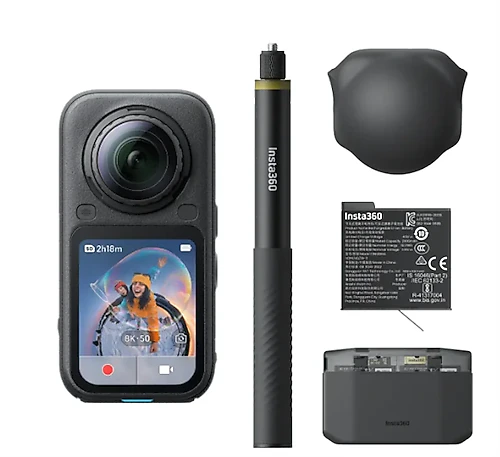
The Insta360 X6 Essentials Kit is a 360-degree action camera designed for people who don't want to commit to a single angle while shooting. Its 8K video, 42 MP photos, image stabilization, and 20-meter water resistance provide a solid foundation for active filming such as hiking, cycling, water sports, and travel. Its key difference is that you can choose your framing after recording: instead of focusing on pointing the camera in the right direction, you can capture the moment and leave that choice for the editing stage.
The advantage of leaving framing until after the shoot
360-degree capture is useful, especially when it's difficult to keep track of where the camera is pointing. While cycling, skiing, or at a crowded event, you can record your entire surroundings instead of locking the camera onto a single scene; later, you can create separate views facing forward, backward, or to the side. This approach is also useful for creators who want to produce different social media formats from the same recording. Creating vertical short videos while preparing a horizontal main video can reduce the need to carry a second camera during the shoot.
Freedom of framing doesn't mean every shot will be perfect. When editing 360-degree recordings, you need to choose which moment and direction to highlight. That makes the X6 a better fit for people who are happy to select and shape their footage afterward than for users who want to shoot and share files immediately. Features such as moving-subject tracking and stabilization can also support this editing approach; even so, you'll need to develop editing habits suited to the way you shoot to get the best results.
8K video and photos: What does high resolution offer?
The X6's 8K video recording at 7680 × 3840 pixels and support for 50 fps are designed to leave room for detail when selecting portions of a wide scene later. This is especially valuable when turning 360-degree footage into a narrower frame: instead of showing the entire scene at once, you can direct viewers' attention to a particular person or action. The 50 fps option helps capture moving scenes smoothly; resolution and frame rate alone don't guarantee image quality, since lighting and shooting conditions also affect the result.
The 42 MP photo resolution also opens up possibilities for landscapes and travel shots, as well as action moments. Timed shooting can make it easier to secure the camera and include yourself in a group photo, or to capture images at set intervals. Wide-angle shooting and 360-degree recording offer a different way to tell a story for people who don't want to be limited by the narrow field of view of a traditional action camera.
These high-resolution files can also require more resources for storage and editing. The camera uses a Micro SD card; before heading out for a long shoot, it's wise to plan card capacity, write speed, and available computer storage together. Editing and exporting 8K footage can be more demanding on basic phones or computers. If you only shoot short clips and share them directly, this resolution may not always be necessary; it makes more sense if you plan to crop footage later and create different framings.
Action shots, water, and ease of use
Image stabilization is an important feature intended to make footage more watchable when unavoidable shake occurs during activities such as running or cycling. Used alongside 360-degree recording, it can make for a more relaxed shooting setup, with the flexibility to choose your framing later. Slow-motion support also offers a different way to highlight movement in sports and action scenes. Before shooting, it's a good idea to check which recording settings support these features, along with your preferred resolution.
The camera's 20-meter water-resistance rating broadens its potential use for water sports and rainy conditions. It may reduce the need to carry an additional housing for plans such as snorkeling, coastal activities, or filming near the water. However, make sure the covers and connection points are properly closed before taking it into the water, and follow the product's safety instructions for diving depth and usage. Dust resistance is also an advantage outdoors, though you should keep the camera clean and dry after using it in sandy or muddy conditions.
The 2.32-inch OLED touchscreen makes it easier to control framing and basic settings on the camera itself. At 196 grams and measuring 50 × 100 × 40 mm, it's portable enough to carry in a bag; however, its weight and size are still worth considering if you're looking for a very small action camera. Voice control can be an alternative for tasks such as starting or stopping a recording when using the touchscreen isn't convenient. Wi-Fi, Bluetooth 5.3, and a Type-C connection provide wireless pairing and wired connection options. If you plan to transfer files or control the camera from your phone, check in advance that your devices and the app you intend to use are compatible.
Battery, kit contents, and shooting plans
The 2600 mAh battery has a stated operating time of 140 minutes and a charging time of 35 minutes. In real-world use, recording settings, how long the screen stays on, wireless connections, and environmental conditions can affect battery performance; for a long day, it's safer to plan for a spare battery or a charging option. Type-C is practical for charging and wired connections, but if you'll be shooting outdoors for a long time, think ahead about your power source and transfer setup.
Before buying, compare the package contents to confirm which accessories are included in the kit called Essentials Kit. The camera body alone may not provide a mounting solution suitable for every type of shooting: depending on your plans, you may need to choose the mounts you'll use for a bike, helmet, or handheld shooting. Also, because 360-degree capture records the area around the camera, how you hold or mount it affects what the footage looks like. It's helpful to test the mount in advance so that you can keep anything you don't want visible in the footage out of the frame.
Who is it right for, and who should consider another model?
The X6's strongest reason to buy is the freedom to leave framing decisions until later when shooting action. Travelers, action-sports enthusiasts, and people who want to create content in different formats from a single recording can benefit from this flexibility. With 8K 360-degree video, 42 MP photos, stabilization, and water resistance combined in one camera, it may appeal to those who want to handle different shooting scenarios with a single body.
On the other hand, if you're looking for a simple, fast action camera that just points forward, the editing workload of 360-degree capture may feel unnecessary. Standard wide-angle models in this category generally offer a more direct workflow from shooting to sharing. When comparing the X6 with other 360-degree cameras such as the GoPro Max, look beyond resolution: consider whether the editing app suits your needs, whether the mounting accessories meet your requirements, and whether the device you'll use to edit the files has enough capacity. The extra cost compared with simpler cameras in a similar category is worthwhile only if you'll actually use the ability to choose your framing later and the 360-degree capture features.
In short, the Insta360 X6 Essentials Kit is aimed less at people who want a single, ready-made angle for every shot and more at those who shape their footage afterward. If 360-degree capture, 8K video, and 20-meter water resistance suit your needs, it's a powerful creative tool; if you don't want to spend time editing, a simpler action camera may be a better choice.