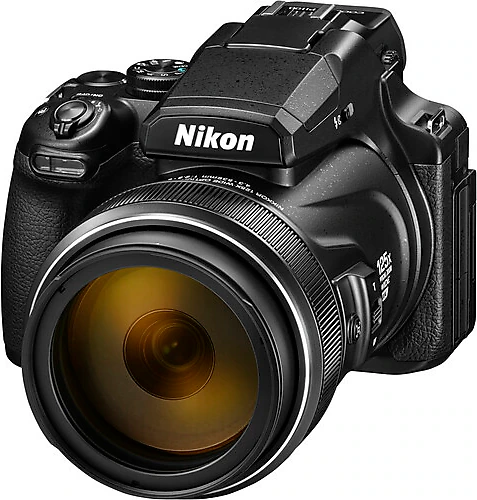
The Nikon Coolpix P1100’s main appeal is its ability to bring very distant subjects into the frame without requiring you to carry separate telephoto lenses. Its 125x optical zoom, electronic viewfinder, and articulating screen make it a good fit for people interested in subjects such as birds, wildlife, aircraft, or the Moon. But don’t let the word “compact” in its name mislead you: at 1,414 grams, it’s a large superzoom camera with its lens built in, rather than a camera you can carry in your pocket.
The freedom of 125x zoom in use
The P1100’s 125x optical zoom alone explains why you might choose this model. Being able to move from a wide angle to a very narrow field of view lets you photograph a distant bird, a detail on a stage, or an architectural feature that’s hard to reach without changing your framing of the surrounding scene. Nikon specifies this lens range as equivalent to a 24–3000 mm field of view. That means you can use the same camera for both images that take in your surroundings and shots focused on distant subjects.
This flexibility is especially useful when tracking moving subjects in nature or when you want to limit the amount of gear you bring on a trip. With an interchangeable-lens system, reaching this far with a telephoto lens would require carrying a large and expensive lens. Since the P1100’s lens is fixed to the body, there’s no need to change lenses, check compatibility, or carry a second lens in your bag. For someone who uses the zoom range often, that’s not just convenient—it also means being able to make decisions more quickly while shooting.
At very long focal lengths, it becomes harder to keep the frame steady; even a small hand movement can cause a large shift in the image. When using the P1100, it’s a good idea to support the camera with both hands, use the electronic viewfinder, and bring a monopod or tripod when needed. 125x zoom doesn’t guarantee easy shooting in every situation; it’s a powerful tool that makes hard-to-reach subjects photographable when you have the right support.
Screen, viewfinder, and shooting controls
The 3.2-inch LCD screen is articulating and touchscreen-enabled, helping the P1100 adapt to different shooting angles. When you raise the camera above your head or bring it close to the ground, you can turn the screen to a viewing angle that suits you. Touch controls also make it more direct to manage framing and settings. The electronic viewfinder is a useful alternative when it’s difficult to see the screen in bright daylight or when you want to hold the camera more steadily against your face.
The built-in flash can provide extra light at close range, while support for an external flash gives those who want more control over lighting another option. The shutter speed range, from 1/4000 of a second to 30 seconds, also accommodates different shooting styles, from freezing motion to long exposures. The ISO range is specified as 100–6400. These figures alone don’t explain image quality; especially in low light, results will depend on the shooting conditions and settings used.
4K video alongside photos
The P1100 can record 4K video at 30 fps. This is a useful complement to its still photography capabilities for anyone who wants to capture a distant event, animal behavior, or landscape details while traveling. An audio input helps those who want more control over sound recording with an external microphone, while the HDMI output makes it easier to send footage to a compatible display.
The long zoom range offers a creative advantage when shooting video, but keeping the subject in frame and the camera steady becomes important. That makes the P1100 a more comfortable option, especially for users who shoot with a tripod or plan to record distant subjects from a fixed position. Travelers, nature enthusiasts, and hobbyist content creators who want to produce both photos and video with one camera can also benefit from this versatility.
Connectivity and everyday use
Built-in Wi-Fi and Bluetooth provide wireless connectivity and let you transfer photos to a compatible smart device. Along with Type-C and HDMI connections, there’s a single SD card slot for photos and videos. If you have a long shoot planned, choosing an SD card with enough capacity in advance and clearing it regularly will help keep the camera ready to use. Carrying a spare battery alongside the lithium-ion battery is also a practical precaution on long trips or days in the field.
The body measures 14.6 × 18.1 × 11.9 cm and weighs 1,414 grams. These dimensions and this weight may be convenient compared with carrying a long telephoto lens separately, but the P1100 is still not a lightweight, small travel compact. When choosing a bag, make room for the body and any accessories you may need, such as a battery, card, tripod, or monopod. Also, its fixed-lens design isn’t suitable for anyone who wants to expand the system later by attaching different lenses.
Who should consider it?
The P1100 is aimed at people who regularly photograph distant subjects, want an exceptionally broad zoom range in a single camera, and don’t want to deal with changing lenses. Birdwatchers, travel photographers, aircraft enthusiasts, and hobbyists who observe the sky can all benefit directly from the 125x zoom. 4K video, an articulating screen, an electronic viewfinder, and a microphone input extend these use cases to video recording as well.
On the other hand, if your priorities are a small bag, low weight, interchangeable lenses, or the ability to expand your system over time with different lenses, this model’s large body and fixed lens may not suit you. A 16 MP resolution doesn’t by itself mean better or worse image quality; when evaluating the camera, consider the sensor class, lighting conditions, and how much you’ll use the long zoom alongside the megapixel count.
Value for money
Whether the price you pay for the P1100 is worthwhile depends on how important 125x optical zoom is to you. If you’ll use its extreme reach often, having such a broad range in one camera can reduce the need for separate telephoto gear and simplify your setup. On the other hand, if you rarely zoom all the way in, a smaller superzoom or a camera system that can be expanded with different lenses may be a better choice. Prices can change, so when making your decision, account not only for the camera body but also for any card, carrying bag, and support gear you’ll need.
The most compelling reason to choose the Nikon Coolpix P1100 is to put reach ahead of portability. If you want to photograph distant subjects with a single camera, shoot 4K video, and choose between an electronic viewfinder and an articulating screen, its features serve that purpose. If you’re looking for a lighter and more flexible camera, consider before buying whether you’ll really use the reach offered by 125x zoom.