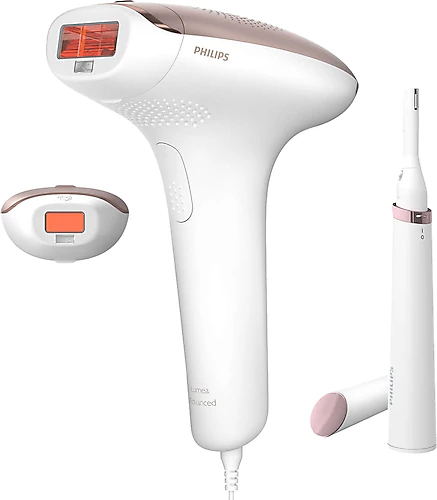
The Philips Lumea Advanced BRI921/00 is a corded IPL device for anyone who wants to carry out regular at-home light-based hair reduction treatments. Its five intensity levels, skin tone sensor, and attachment designed for smaller areas make it easier to tailor use to your personal routine. Its 250,000 flashes also make it suitable for a treatment plan based on repeated sessions rather than one-off use.
For regular at-home treatments
This model is a good fit for anyone who wants to maintain their routine at home on larger areas such as the legs and arms, without relying on salon appointments. Its attachment helps provide more controlled treatment on sensitive areas, so the device is not limited to larger surfaces; you can address different body areas as part of the same routine. Still, IPL should not be thought of as a treatment that delivers instant results: an effective routine requires regular use and following the device’s instructions.
Although it is sold under the Philips Lumea Advanced name, the term “laser hair removal,” often used in this category, does not fully describe how the device works technically. The BRI921/00 uses IPL light pulses. Since results can vary depending on the person and their hair and skin characteristics, it’s important to check the suitability information in the user manual before buying. The skin tone sensor is useful here: it helps assess your skin tone before treatment and can warn against use on unsuitable tones.
Choose the intensity and treatment area
Five levels let you choose the light intensity rather than being limited to a single setting. Starting at a low level the first time and adjusting based on your comfort can provide a more controlled experience, especially on sensitive areas. Taken together, the sensor and levels offer more personalized use than a “one setting fits all” approach. UV protection is another protective feature for light-based treatments; however, you should still follow the specified preparation and treatment steps to use the device safely.
The attachment, designed for precision and use on sensitive areas, makes it easier to target light at smaller spots. This lets you move between treating larger areas and working more carefully on areas that need extra attention. According to the catalog information, the box contains one attachment, so don’t assume that separate attachments are included for different functions. It’s a good idea to check the product description to confirm the package contents and which areas the attachment can be used on.
The benefits and limitations of corded use
The BRI921/00 is corded. This means you don’t need to charge a battery during a session or wait for a depleted battery to recharge; you just need to plan your treatment somewhere with access to a power outlet. On the other hand, the cord limits your freedom of movement. The outlet’s location and whether the cord can reach comfortably become important, especially when treating different parts of your body. Although this personal care device can be stored in a small drawer, you’ll need to set aside a space near an outlet where you can sit or lie down comfortably.
The 250,000 flashes are an important indicator of the device’s usage capacity. This figure is relevant for anyone planning to use it over a long period with regular sessions, but how long the device will last depends on how often you use it and the size of the areas treated. Consider the flash count as one part of planning for long-term use, not as a guarantee of results.
How it compares with similar models
Compared with options such as Philips’ higher-end Lumea models and the Braun Silk-expert Pro series, the BRI921/00 stands out for combining basic IPL treatments with a skin tone sensor and five setting levels. Those looking for more attachments, different automation features, or faster area coverage may prefer higher-end models; if those differences won’t make a real difference to your routine, there’s no need to pay extra for additional features. The BRI921/00’s corded design also won’t suit those looking for cordless convenience, but it may be practical for users who don’t want to manage a battery.
If it is reasonably priced compared with entry-level and mid-range IPL devices with similar capacity, the added cost for the sensor, five intensity options, and attachment suited to smaller areas is easier to justify. It’s a well-balanced choice, especially for people who plan to treat themselves regularly at home and value basic flexibility over a variety of attachments. If cordless use, numerous specialized attachments, or the fastest possible treatment is a priority, consider models that meet those needs before buying.