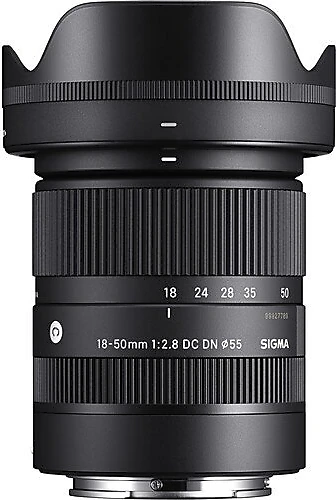
The Sigma 18-50mm f/2.8 DC DN Contemporary Sony E Lens is a versatile zoom lens designed for use with Sony cameras featuring APS-C sensors. Its 18-50 mm focal-length range offers photographers a practical option for adapting to different shooting needs with a single lens. The near-wide-angle 18 mm end makes it easier to fit broader scenes into the frame, while the 50 mm end can be used for shots that focus more closely on the subject and offer a narrower perspective. The f/2.8 aperture and autofocus support also make this design practical for everyday photography.
Key aspects of the design and intended use
Three features are at the center of this model: its zoom design, APS-C sensor compatibility, and Sony E mount connection. As a zoom lens, it reduces the need to change lenses constantly for different framings. When photographers want to show the entire scene, they can turn to the 18 mm end; when they want a composition that moves closer to the subject, they can use the 50 mm end. This transition is particularly useful when it is not physically possible to move farther away from or closer to the shooting area.
The 18-50 mm range provides a flexible foundation for everyday use without being tied to a single type of photography. Street photos, different scenes encountered while traveling, indoor images, and snapshots of daily life can all be handled at different focal lengths with the same lens. The advantage here is not that it guarantees the ideal result in every scenario, but that it allows photographers to reach different framing options quickly with the same equipment.
Its compatibility with APS-C sensor bodies clearly defines the lens’s intended use. The Sony E mount allows the lens to be used with compatible bodies that use Sony’s mounting standard. For this reason, when choosing a lens, it is important to consider not only the brand but also the camera’s sensor type and mount connection. This model makes sense as part of a system when the APS-C sensor and Sony E connection are considered together.
What does the 18-50 mm focal-length range offer for everyday photography?
Starting at 18 mm gives you an advantage in scenes where you need to include a larger portion of the surroundings in the frame. It can serve as a starting point for compositions that aim to capture architectural details, landscapes seen while traveling, or the overall atmosphere of a setting. In indoor spaces, its broader perspective also helps address the need to fit more of the area into the frame.
At the 50 mm end, the frame focuses on a more limited area. This can be useful for those who want to reduce distracting elements in the surroundings or give greater emphasis to a particular subject. This end can be preferred for everyday portrait-like shots, scenes that emphasize details, and subjects selected from a distance. The lens’s zoom range gives photographers the freedom to try different visual narratives within the same scene.
Compared with a prime lens, this range provides greater flexibility when changing the framing. Instead of always taking a few steps forward or backward to adjust the composition, you can use the zoom ring. This approach can save time, particularly when the action is fast or the subject changes position. Even so, using a zoom does not change the fact that each focal length provides a different perspective; wider and tighter framings create a different visual arrangement in the photograph.
The contribution of the f/2.8 aperture
The Sigma 18-50mm f/2.8 DC DN Contemporary Sony E Lens features an f/2.8 aperture. Aperture is a fundamental element directly related to the amount of light passing through the lens and the image produced by the shooting settings. The f/2.8 value allows photographers to consider using a wider aperture in environments where sufficient light is not available. This can become important indoors, during less brightly lit times of day, or in scenes where preserving the available light is desirable.
The effect of aperture is not limited to light alone. Photographers also use aperture according to the composition and subject when determining shooting settings. When trying to separate a subject from its surroundings or preserve the overall atmosphere of an image, the f/2.8 option can be part of the creative control available. However, the result also depends on other factors such as the camera body, shooting distance, focal length, subject, and ambient light. Therefore, the f/2.8 value should not be considered a guarantee of a specific image result on its own.
This value is one of the important technical features that allows the lens to be used in different lighting conditions. In particular, for users who want to take both outdoor and indoor photos with a single lens, the expanded usability provided by the aperture option is a practical benefit.
Smoother shooting with autofocus
The lens’s autofocus support makes things easier for users who do not want to set focus manually or who need a quick response while shooting. In everyday use, autofocus can simplify the workflow when following a moving subject, capturing a fleeting scene, or switching quickly between the frame and subject during a shoot.
Autofocus can also help users who are new to photography focus more easily on the basic shooting process. For experienced users, it provides a quick starting point before switching to manual adjustment. This allows users to pay more attention to composition, light, and timing instead of setting the focus manually from scratch for every frame.
The convenience offered by autofocus should be evaluated together with factors such as the body with which the lens is used and the body’s focusing system. Even so, this feature can be said to make the lens more accessible and practical for everyday use. It is an important function for those who want to capture both ordinary moments and more carefully planned shots with a single lens.
Who is it suitable for?
This lens is aimed at users of APS-C cameras with a Sony E mount who want to cover different types of photography with a single lens. For users who carry their camera while traveling, around the city, at family events, or in daily life, the 18-50 mm range can provide a practical starting point. Being able to move from wider to tighter framing makes it easier to work across different scenes without changing equipment.
It also has an accessible use case for those new to photography. Users can try different framings without dealing with the limitations of a fixed focal length and observe how the image changes as the focal length changes. More experienced photographers may consider this range as everyday carry equipment or as the core component of a different shooting setup.
The product’s design for APS-C Sony E bodies means compatibility should be checked in advance when making a selection. When paired with the correct body and mount standard, the model brings zoom flexibility, an f/2.8 aperture, and autofocus together in one design.
Overall assessment
The Sigma 18-50mm f/2.8 DC DN Contemporary Sony E Lens combines its technical features in a design that can be used directly for everyday photography. The 18-50 mm zoom range offers transitions between different framings, while the f/2.8 aperture provides additional flexibility in lighting conditions and shooting preferences. Autofocus also supports expectations for quick and practical use.
The model’s strongest aspect is its ability to adapt to different scenes without being limited to a single focal length. It stands out as a balanced option for users shooting with APS-C Sony E bodies who want to keep their equipment simple. Those looking for a zoom lens that can be considered for everyday photography, travel, street photography, and shooting in various environments can benefit from the focal-length range and aperture value this lens offers.