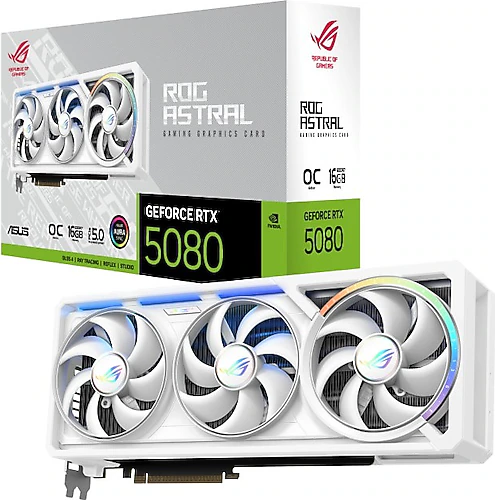
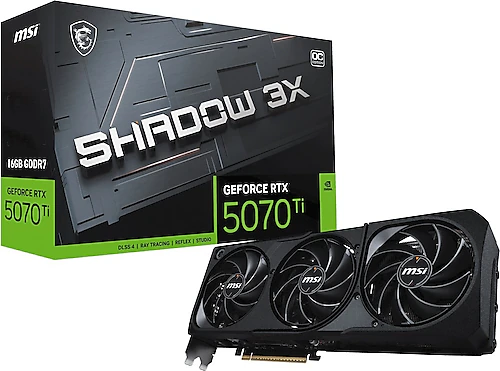
The Asus RTX 5080 ROG Astral White OC Edition and MSI RTX 5070 Ti Shadow 3X OC 16G are two high-end graphics cards with similar memory hardware. Both have 16 GB of GDDR7, a 256-bit memory interface, DLSS, G-Sync, and factory overclocking. However, the RTX 5080 belongs to a higher GPU class, while the MSI has a shorter cooler with fewer fans. Your choice depends not only on their shared features, but also on the performance level you’re targeting and the space available in your system.
How high are your gaming performance goals?
The RTX 5080 ROG Astral White OC is for those seeking the higher GPU class of the two. Asus is the more ambitious option for players looking to make the most of high refresh rates at 1440p, target high graphics settings at 4K, and use features such as ray tracing. DLSS can also help balance image quality and smoothness in compatible games. Of course, results vary by game and settings, so it’s best not to assume a specific performance gap in every game based on the model names alone.
The MSI RTX 5070 Ti Shadow 3X OC 16G is aimed at players who want a powerful card for high-end gaming, higher detail settings at 1440p, or a strong option for moving to 4K. DLSS and the latest RTX 50 series features in compatible games also make this model worth considering for high-resolution gaming. If your priority is moving up to the highest GPU class, Asus is the better fit; if you want a powerful card for gaming and productivity in the same system, MSI is also worth considering.
Memory and creative work: shared strengths
Memory capacity isn’t a clear differentiator in this comparison: both cards have 16 GB of GDDR7 and a 256-bit memory interface. This shared hardware supports a wide range of uses, including high-resolution textures and GPU-accelerated tasks. However, memory capacity alone doesn’t determine performance in every game or application; requirements for large projects depend on the software and workload.
Video editing, 3D work, and other GPU-accelerated applications are also worth considering when comparing the cards. Both support HDMI and DisplayPort, DirectX 12 Ultimate, and OpenGL 4.6. That makes it difficult to choose between them based only on these shared features. Choose Asus if you prioritize the higher GPU class; choose MSI if you prefer to stay in the RTX 5070 Ti class while retaining 16 GB of memory.
Case compatibility and cooler dimensions
Physical dimensions are among the most practical differences between these models. The Asus card is 357.6 mm long and 149.3 mm tall. Its four-fan cooler and large body make a striking addition to a white-themed build, while ARGB lighting gives you the option to customize the look inside your case. The trade-off is that it needs plenty of room. Check not only the graphics card clearance, but also the space needed for front fans, a radiator, and the power cable.
The MSI card has three fans and measures 303 mm long, 121 mm tall, and 49 mm wide. Its shorter length compared with the Asus may make it easier to plan for case fit, though these dimensions don’t guarantee that it will fit every case. Check the case’s GPU clearance and the components around it. MSI lists a power rating of 300 W; when choosing a power supply, also consider the rest of the system and the required connections. For the Asus’s power requirements, check the system requirements specified by the manufacturer.
Choosing between design and card features
One of the Asus card’s strengths is its white ROG Astral design, combined with four-fan cooling and factory overclocking. This approach may be appealing if you’re building a visually distinctive system with a white theme. MSI is also factory-overclocked, with a shorter body and a three-fan cooler. Fan count alone doesn’t indicate cooling performance or noise levels; operating conditions depend on factors such as case airflow and load.
Final verdict: Which card is right for you?
The Asus RTX 5080 ROG Astral White OC Edition is the better choice if you prioritize the higher GPU class, a white ROG look, ARGB lighting, and a four-fan design. Make sure you have a case that can accommodate the large card and that your needs justify a higher GPU class.
The MSI RTX 5070 Ti Shadow 3X OC 16G is a better fit if you want 16 GB of GDDR7 and factory overclocking in a shorter card body. Comparing dimensions can make the decision easier, especially if case space is a key factor. In short, choose Asus for the highest GPU class and white ROG design; choose MSI if you’re looking for a powerful RTX 5070 Ti-class card for gaming and productivity.