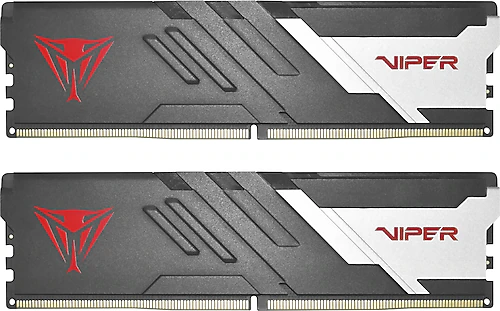
The Patriot Viper Venom PVV532G600C30K offers 32 GB of capacity across two 16 GB DDR5 DIMM modules. Its 6000 MHz frequency and CL30 latency make it a compelling option, particularly for gaming PCs and desktop systems that can benefit from high memory speeds. The kit’s appeal is about more than speed: taken together, its capacity, module configuration, and latency make it a balanced choice for both everyday use and performance-focused gaming.
The advantages of combining 6000 MHz and CL30
This two-module kit is designed to take advantage of a motherboard’s dual-channel memory configuration. Unlike a single 32 GB module, using two modules allows the system to operate in dual-channel mode. The actual benefit varies depending on the processor and application, but this is the preferred configuration for gaming PCs. The 32 GB capacity also leaves plenty of room to keep tools such as a browser, chat app, and game launcher open while playing modern games.
A speed of 6000 MHz is a performance-focused level for DDR5 systems, while the CL30 timings are aimed at keeping latency low at that speed. On paper, CL30 offers an advantage over a kit at the same frequency with looser timings. However, the difference in games is not always large or consistent across systems: the graphics card, processor, game engine, and resolution also affect the results. Even so, choosing fast, low-latency memory can make sense in high-frame-rate games where processor performance matters.
Beyond gaming and everyday use
This kit is not just for gaming. Its 32 GB of memory is useful for people who work with many tabs and applications at once, edit photos, write code, or handle moderate content-creation workloads. It also offers more headroom than entry-level single-module or lower-capacity kits for multitasking scenarios such as running streaming software or voice chat in the background while gaming.
Of course, memory capacity should be considered in the context of your workload. For a workstation handling very large video projects, demanding 3D scenes, virtual machines, or large datasets, 32 GB may eventually become a limitation. If that describes your use case, also consider your motherboard’s maximum supported capacity and whether you plan to upgrade to more memory later. For general gaming and productivity PCs, however, 32 GB is a reasonable balance of capacity and cost for most users.
Installation and compatibility considerations
This model is DDR5 DIMM memory for desktop computers. It cannot be installed in a motherboard with DDR4 slots and is not a replacement for the SO-DIMM modules used in laptops. Before buying, check that your motherboard supports DDR5 and that your processor is compatible with the memory. Slot placement matters too: install the two modules in the slots recommended for dual-channel operation in your motherboard manual. These are often labeled A2 and B2, though the correct placement can vary by motherboard model.
The memory may run at default speeds on its first boot. You may need to enable the kit’s speed profile in the BIOS to reach 6000 MHz. Motherboard and processor support for this speed is important for stable operation; memory overclocking profiles do not guarantee the same results on every system. After installation, checking the memory speed shown in the BIOS is a practical way to confirm that the kit is running at its intended setting. If your system already has memory installed, using a compatible matched kit is generally a smoother option than mixing modules with different speeds and timings.
Comparing similar kits and making a buying decision
There are many two-module kits in the DDR5-6000 class with different latency ratings. The Patriot Viper Venom stands out by combining 6000 MHz with CL30, distinguishing it from options at the same speed with higher latency. When comparing competing kits with similar specifications, consider more than the brand name or frequency: evaluate the latency, your motherboard’s support for memory profiles, and your capacity needs together. RGB-lit models may offer a different look or additional software features, but if those are not a priority, this kit’s main appeal is its combination of speed and timings rather than lighting.
If its price is close to that of kits with the same capacity and speed but looser timings, such as CL36, paying extra for CL30 may be worthwhile—especially if you are building a performance-focused system. If the price difference is substantial, consider whether putting that money toward a graphics card or processor would deliver better results rather than expecting a major gaming gain in every situation. Overall, the Patriot Viper Venom 32 GB is a balanced, straightforward choice for anyone who wants two modules, 6000 MHz speed, and CL30 timings in a compatible DDR5 desktop system.