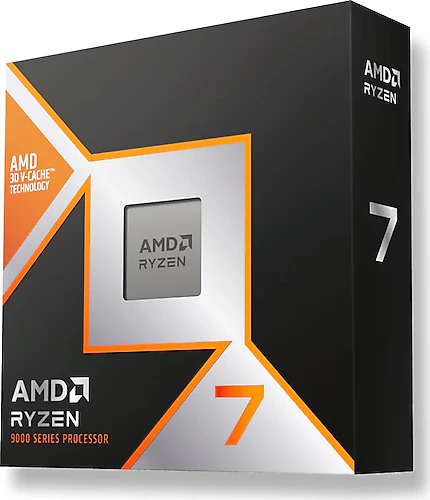
The AMD Ryzen 7 9800X3D is an 8-core desktop processor designed for people who put gaming performance at the heart of their system. Combining Zen 5 architecture with second-generation 3D V-Cache, it aims to deliver high frame rates, keep a powerful graphics card fed, and handle background tasks while you play. With a 4.7 GHz base clock, boost speeds of up to 5.2 GHz, and 16 threads, it is also a fast desktop processor with uses beyond gaming.
Cache is what makes the difference in games
The 9800X3D’s distinguishing feature is its 96 MB of L3 cache. When a game engine can keep frequently accessed data close to the processor, delays caused by memory access can be reduced. That does not mean it will make the same difference in every game, but the cache advantage is especially valuable in scenarios where high frame rates matter and the processor can become the bottleneck. This is where the model makes a strong case for players who want to get the most out of a high-refresh-rate monitor in competitive games or target smooth frame times in large, detailed game worlds.
This advantage may not be as noticeable in every setup where the graphics card carries most of the load. For example, when you increase the resolution and graphics settings, the graphics card may handle most of the work; in that case, a faster processor may make only a limited contribution to frame rates. So when choosing the 9800X3D, consider not just the processor but also your graphics card and the games you play. It makes more sense as an investment in a system targeting high frame rates with a high-end graphics card, while those building a balanced system with a more modest graphics card may get better results by putting that budget toward the graphics card.
8 cores that are useful beyond gaming
With 8 cores and 16 threads, the processor provides plenty of room for multitasking while keeping chat apps, streaming software, a browser, and recording tools open alongside a game. Video editing, software development, and everyday productivity tasks are also within its capabilities. Still, if your priority is sustained, demanding workstation workloads, processors with more cores may be better in some applications. The 9800X3D’s main value proposition is combining gaming performance with strong general-purpose capabilities—not being the fastest option for every professional workload.
Zen 5 architecture and boost speeds of up to 5.2 GHz are also intended to provide a responsive experience in single-threaded tasks outside gaming. Virtualization support gives users flexibility to run virtual machines with compatible software. PCIe 5.0 support also opens the door to next-generation storage and graphics card connection options with compatible motherboards and components. This support does not mean that every installed SSD will automatically run at PCIe 5.0 speeds; the correct motherboard slot and component compatibility matter.
Things to keep in mind when building an AM5 system
The processor uses the AM5 socket and requires DDR5 memory. That means you cannot use the 9800X3D by carrying over an older AM4 motherboard or DDR4 memory to your new system. When choosing an AM5 motherboard, check processor support and whether a BIOS update is needed. If you plan to use a memory overclocking profile, check that the motherboard and memory kit are compatible as well; the right configuration can affect the performance you get after setup.
The 120 W TDP should be taken into account when choosing a case and cooler. If you plan to game for long sessions or run the processor under load, choose a case with adequate airflow and a cooler capable of keeping the processor at suitable temperatures. Consider cooler size, available space inside the case, and your preferred noise level—not just the processor’s name. Overclocking support gives you more room to adjust settings, but performance gains depend on cooling, the motherboard, and the settings used. Don’t assume that overclocking will deliver a major improvement in every system just because the feature is available.
Who should choose it over the Ryzen 7 7800X3D?
The Ryzen 7 7800X3D is also a powerful gaming-focused alternative that uses 3D V-Cache. The 9800X3D stands out for those who want a newer architecture and higher operating frequencies, with its Zen 5 foundation and 4.7–5.2 GHz frequency range. On the other hand, if the 7800X3D is significantly more affordable and your goal is already strong gaming performance, the previous model may be the better-value choice. Whether the price difference is worthwhile depends not just on the processor generation, but also on your graphics card, resolution, game genres, and budget.
Spending more on the 9800X3D makes the most sense in games that approach the processor’s limits, especially with a powerful graphics card and a high-refresh-rate display. For a general-purpose computer or production work where core count matters more, more affordable options or processors with more cores may better suit your needs. In short, the strongest reason to choose this processor is that gaming performance is your top priority and the rest of your system supports that goal.